Media Room vs Home Theater: Which Is Right for Your Houston Home?
A media room and a home theater are different rooms with different jobs. Learn which one fits your luxury home.
Media Room vs Home Theater: Which Is Right for Your Houston Home?
An honest comparison from Texas' premier audio, video, and automation integrators.
If you've started planning the entertainment space in your next custom build or renovation, you've probably noticed the two terms keep getting used interchangeably — and they shouldn't. A media room and a home theater are different rooms with different jobs. Choosing the wrong one early in a project means the wrong space, the wrong budget, and a result that never quite fits how you actually live.
Here's the short version: A home theater is a dedicated, light-controlled room engineered for cinematic immersion — projector, theater seating, acoustic treatment, isolated audio. A media room is a multipurpose space designed to perform beautifully with the lights on — a large 4K TV or short-throw projector, comfortable sectional seating, and surround sound tuned for daily life.
A home theater is a destination. A media room is a room you live in.
For most luxury Houston homes — especially the larger builds we work on in River Oaks, Memorial, Bellaire, Katy, Sugar Land, and The Woodlands — the right answer is often both. One space for everyday family life. One space for movie nights, big games, and immersive viewing. Below, we'll break down what separates the two, when to choose which, what each costs in real Houston builds, and how to design a home that can accommodate either path gracefully.
Quick Comparison at a Glance
| Feature | Media Room | Home Theater |
|---|---|---|
| Purpose | Multipurpose entertainment + daily living | Dedicated cinematic experience |
| Lighting | Designed to work with lights on; windows OK | Light-controlled; blackout required |
| Display | Large 4K/8K TV or short-throw projector (75"–136") | 4K/8K laser projector with screen (120"–200"+) |
| Audio | 5.1 or 7.1 surround sound; refined for daily comfort | 7.2.4 or 9.2.4 Dolby Atmos; reference-grade |
| Acoustic Treatment | Light or none; some absorption | Full engineered acoustic environment |
| Seating | Sectional sofas, sectionals, swivel chairs, ottomans | Tiered theater seating in rows |
| Room Type | Open or shared space; bonus room, great room, basement | Fully enclosed, isolated room |
| Sound Isolation | Minimal — sound carries to adjacent rooms | Dedicated decoupled construction |
| Typical Houston Cost | $15,000 – $80,000 | $45,000 – $250,000+ |
| Ideal For | Families, hosting, sports, gaming, casual viewing | Movie lovers, audiophiles, immersive cinema |
| Best Location | Living area, great room, basement bonus, second-floor lounge | Dedicated basement, converted bedroom, designed-in cinema |
This is the framework. The details below are what determine which one fits your home.
The Official Distinction (And Why It Matters)
The Home Technology Association — the trade body that certifies luxury AV integrators across North America — defines these two spaces in language worth knowing:
- A home theater is "a space optimized for a theatrical experience" — a fully controlled environment built to deliver the best possible audio and video performance, with acoustic isolation, light control, and engineered seating.
- A media room is "a multipurpose living space with a high-quality entertainment setup designed to fit into everyday life" — flexibility over absolute performance.
The distinction matters because the design choices flow from the definition. A home theater is built backwards from the cinematic experience. A media room is built forward from how the family lives. Get the category right and every subsequent decision becomes simpler.
What Defines a Media Room
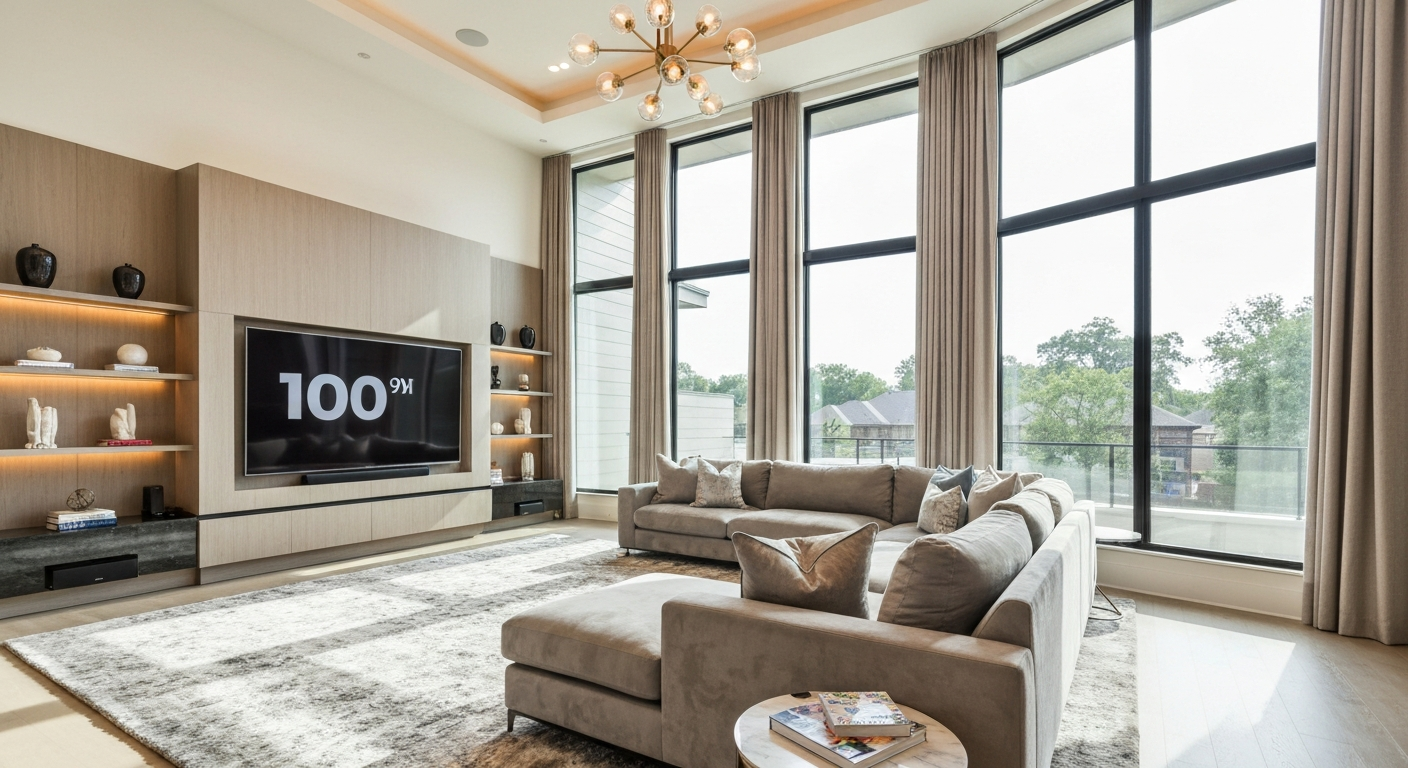
A luxury media room is the most-used entertainment space in nearly every Houston home we work on. It's where the family actually lives — Netflix on a weeknight, the Texans on Sunday, Mario Kart with the kids on Saturday, a glass of wine with friends after dinner.
Designed to Perform With the Lights On
Media rooms have windows. They have overhead lighting on. They live next to kitchens, breakfast nooks, and great rooms. Everything in the design has to perform under ambient light — which is why large-format 4K and 8K displays (75" – 136" Sony, LG, Samsung) have largely replaced projectors in this category. MicroLED and OLED panels deliver theater-level image quality without any of the light-control demands of a projector.
A short-throw or ultra-short-throw laser projector can also work beautifully here, especially the new generation that handles ambient light well. Either path delivers a great image without darkening the room.
Multipurpose Seating
Sectional sofas, swivel chairs, oversized ottomans, modular pieces that can be rearranged for a viewing party or a quiet evening. The room functions as a living space first and an entertainment space second. Theater seating in rows would feel out of place.
Surround Sound — Refined, Not Maxed Out
A 5.1 or 7.1 surround configuration with in-wall and in-ceiling speakers tuned for everyday listening rather than reference-level dynamics. The audio should be powerful enough for action movies and clear enough for dialogue and conversation — without rattling the windows in the next room.
Flexible Integration
The media room is usually one zone in a whole-home audio and automation system. Music carries from the kitchen to the media room to the patio. Lighting scenes shift from "morning" to "afternoon" to "movie." A single touchscreen or remote controls everything in the room without requiring the user to think about it.
Locations That Work
Media rooms thrive in great rooms, second-floor lofts, basement bonus rooms, finished garages, and open-plan living areas. Anywhere the family already congregates.
What Defines a Home Theater
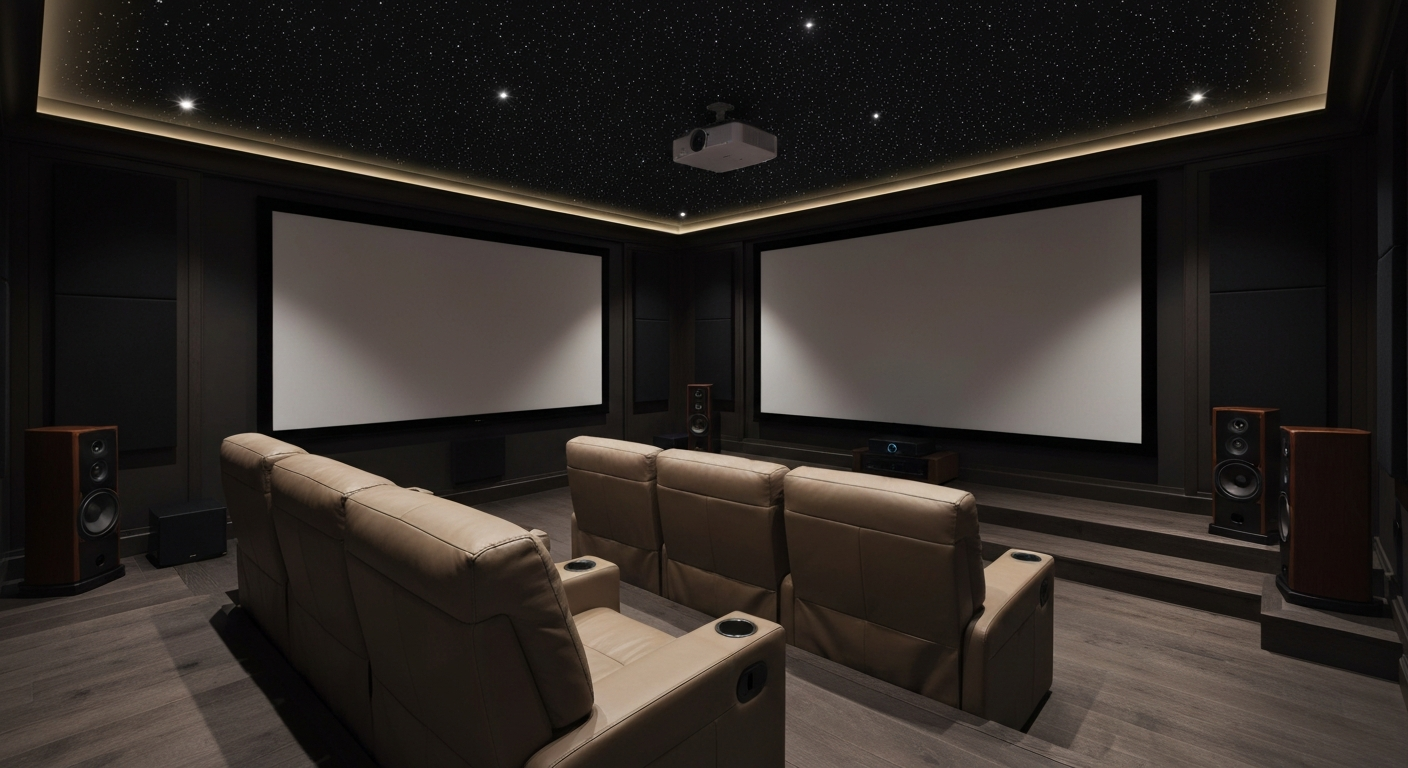
A home theater is a different animal entirely. It's a room engineered as a system — every architectural, acoustic, and design choice subordinated to one goal: cinematic immersion.
Dedicated, Light-Controlled Construction
A home theater is enclosed, isolated, and blackout-capable. No windows, or fully blackout-shaded windows. Walls treated for acoustics. Doors with acoustic seals. Often built below grade or in interior rooms with no exterior walls for ideal isolation. The room exists for one purpose, and the architecture commits to that purpose entirely.
Projector + Acoustically Transparent Screen
A 4K or 8K laser projector (Sony, JVC, Barco, Christie) paired with a screen sized for the room — typically 120" to 200" diagonal. An acoustically transparent screen lets the center channel speaker sit behind the screen, exactly where it belongs. The image is large enough to fill the viewer's peripheral vision, which is what creates the cinematic feel.
Full Dolby Atmos Audio
A serious home theater audio system uses a 7.2.4 or 9.2.4 Atmos configuration — 11 to 13 speakers including overhead height channels, dual subwoofers, reference-grade amplification. This is the gear that delivers genuine immersion: sound that comes from above, behind, beside, and below the listener with millimeter precision.
Hidden architectural speakers from Sonance, Triad, James Loudspeaker, or Origin Acoustics keep the visual environment clean while delivering reference performance.
Engineered Acoustic Environment
This is where home theaters earn their reputation. Bass traps in corners, absorption panels at first-reflection points, diffusion on the rear wall, decoupled wall construction, solid-core doors with acoustic gaskets. None of it visible — all of it inside designer fabric panels and architectural elements.
A reference-grade audio system in an untreated room sounds worse than a modest system in a properly treated one. This is non-negotiable in a true home theater.
Tiered Theater Seating
Real theater seats from Fortress, Cinematech, Cineak, Elite HTS, or Valencia. Power recline, heated/cooled cushions, tactile transducers (bass shakers), console storage, integrated drink rails. Typically arranged in two rows on a riser, configured around sightlines and viewing angles.
Engineered as an Architectural Experience
Curtains, sconces, fabric-wrapped acoustic walls, a proscenium frame around the screen, fiber-optic starfield ceilings, custom millwork, themed entry vestibules. A luxury home theater feels like a destination from the moment you walk in — and that's intentional.
For a deeper dive into the design language, see our guide on luxury home theater design ideas.
Smart Home Integration With One-Touch Scenes
A proper Control4 or Savant integration ties projector, audio, lighting, motorized shading, climate, and sources into a single scene. "Movie" — and the room transforms in four seconds.
Where Each One Wins
Where a Media Room Wins
- 1. Daily life. Media rooms get used multiple times a day. Home theaters typically get used a few times a week.
- 2. Hosting. Sectional seating works for guests in a way theater rows simply don't.
- 3. Flexibility. Need the space to double as a game room or lounge? Media rooms accept that.
- 4. Cost-to-use ratio. A $40,000 media room used daily costs a fraction per hour of use of a $40,000 home theater used twice a month.
- 5. Architecture-friendly placement. Slots into existing living areas easily.
- 6. Sports and gaming. A bright, social environment works better for these uses.
Where a Home Theater Wins
- 1. Image quality at scale. A 150" projected image in a dark room is an experience a 98" TV cannot replicate.
- 2. Audio performance. A properly engineered acoustic environment with reference-grade Atmos is a different category.
- 3. Immersion. The combination of darkness, scale, and isolated sound creates true cinematic feeling.
- 4. Architectural identity. Becomes one of the most distinctive spaces in a luxury home.
- 5. Resale appeal. Dedicated home theaters consistently rank among the most-desired features in the $2M+ Houston market.
- 6. Single-purpose discipline. No compromises. Every decision gets to be the best version of that decision.
How Houston Homeowners Actually Choose
After designing both kinds of spaces across hundreds of Texas projects, here's the honest framework we use in consultations.
1. How big is the home?
In luxury Houston builds above 6,000 square feet — which is most of what we see in River Oaks, Memorial, Tanglewood, and the larger Woodlands estates — there's often room for both. A media room on the main floor for daily family use. A dedicated home theater on the lower level or in a converted bedroom for cinematic viewing. This is the most common path for our high-end clients.
For homes between 3,500 and 6,000 square feet, the choice is usually one or the other. The media room wins more often, simply because the family will use it more.
2. How does the family actually entertain?
The honest test: how many hours per week will each space realistically get used?
- If your family watches a movie or show together five nights a week, a media room is irreplaceable.
- If movie nights are a Saturday tradition, big games are a weekly event, and immersive cinema is something you genuinely value — a home theater earns its keep.
- If you do both, plan for both.
3. Where in the home will the room live?
Architecture forces some answers:
- Open-plan main floor → media room. Almost always.
- Finished basement or below-grade space → home theater, with light control already half-solved.
- Second-floor bonus room → media room (usually has windows and shared walls)
- Converted interior bedroom → ideal home theater retrofit
- Dedicated room in new construction → home theater, designed-in from framing
4. Are you in new construction or retrofit?
If you're working with a custom builder in The Woodlands, Cinco Ranch, Bridgeland, or Riverstone right now — this is the moment to decide. Pre-wiring during framing makes either path dramatically less expensive.
5. What's the realistic budget?
A media room is generally the lower-cost path for comparable luxury finish. See our full home theater pricing breakdown for more detail.
The Hybrid Approach Most Luxury Homes Take
For the majority of our luxury Houston clients, the most rewarding answer isn't either/or — it's a beautifully integrated media room for daily life, paired with a dedicated home theater for the experience nights that justify going downstairs (or upstairs, or across the house).
Both rooms run on the same home automation backbone, so a single "Movie" scene in either space coordinates everything in the room — and a single app or touchscreen runs the rest of the house. For a full breakdown of the automation layer, see our guide on smart home installation cost in Houston.
What Both Spaces Get From a Professional Integrator
Regardless of which path you take, the elements that determine whether the space feels finished are the same:
- Architectural design coordination with your builder and interior designer from the framing stage forward
- Clean wiring and installation — no visible cables, no compromise on architectural intent
- Hidden architectural speakers that disappear into the walls and ceiling
- Calibration of the audio and video systems to the actual room, not factory defaults
- One-touch automation through Control4, Savant, or Crestron — never multiple remotes
- Lutron lighting scenes that turn the room from "everyday" to "viewing" in seconds
- Motorized shades integrated with the lighting scenes
- Long-term service and software updates to keep the system current
Why Houston Homeowners Bring Us Into the Conversation Early
AudioVision Design has been designing and installing both media rooms and home theaters across Texas since 1997. We work directly with custom builders, architects, and interior designers from the framing stage forward — which is when the right decisions are still cheap.
Ready to Plan Your Media Room or Home Theater?
If you're planning a new build, a renovation, or you're ready to design the entertainment space your home has been missing — the next step is a conversation.
Sales (713) 501-6932 · Office (832) 916-6755
Frequently Asked Questions
What's the main difference between a media room and a home theater?
A home theater is a dedicated, light-controlled room engineered for cinematic immersion — projector, theater seating, acoustic treatment, and isolated audio. A media room is a multipurpose living space designed to perform well with ambient light — typically a large 4K TV or short-throw projector, sectional seating, and surround sound. The home theater is a destination; the media room is a space you live in.
Which is better for a luxury Houston home?
It depends on how you actually live. Most luxury Houston homes above 6,000 square feet can support both. For smaller luxury homes, the media room is more often the right answer because it gets used more often.
How much does a media room cost vs a home theater in Houston?
A professionally designed media room in a luxury Houston home typically runs $15,000 to $80,000. A dedicated home theater ranges from $45,000 to $250,000+ depending on size, equipment, and finish level.
Can I use a media room as a home theater?
It can deliver an excellent viewing experience, but it can't fully replicate a true home theater. A media room operates with ambient light, has minimal acoustic treatment, and lives within the home's daily flow.
Do I need a projector for a home theater?
For a true home theater experience, yes. A 4K or 8K laser projector with a properly sized screen (120" to 200" diagonal) is what delivers the cinematic scale that defines the category. For a media room, large-format MicroLED or OLED TVs (98" to 136") often deliver better daily performance.
Is a media room or home theater better for resale value in Houston?
Both add value in the Houston luxury market, but in different ways. A dedicated home theater is consistently among the most-desired luxury features in the $2M+ Houston resale market. A well-designed media room appeals to a broader range of buyers because of its flexibility. For most luxury homes, having a home theater is the stronger resale signal.
AudioVision Team
AudioVision Design · Texas
Ready to Plan Your Project?
Get a free consultation with our team — no pressure, no hard sell.