Best Home Theater Design Ideas for Luxury Homes
Design principles, room concepts, and signature details from Texas' premier AV and automation integrators. How a luxury room should think.
The best luxury home theaters don't look like theaters. They look like architecture — rooms designed with the same intention as a primary suite or a wine cellar, where the technology is engineered to disappear and the experience is engineered to feel inevitable.
If you're planning a media room for a new build in Memorial, a renovation in River Oaks, or a dedicated cinema in your custom Hill Country estate, the design choices you make now will define how the space feels for the next twenty years. Get them right and the room becomes the most-used part of the house. Get them wrong and you've built a beautiful problem.
What Defines a True Luxury Home Theater
Luxury home theater design lives at the intersection of five disciplines. A media room that nails three of the five feels nice. A theater that nails all five feels transcendent.
1. Start with the Room, Not the Gear
The single most common mistake in luxury home theater projects is starting with the equipment list. Equipment is the last decision, not the first.
A great home theater room in a Texas-sized home typically has rectangular geometry (not square — square rooms create acoustic nightmares), a length-to-width ratio of roughly 1.5:1 (think 18' × 24' or 20' × 28'), and ceiling height of at least 9 feet — ideally 11–14 feet for premium builds.
In new construction across The Woodlands, Katy, and Cinco Ranch, we work directly with custom builders during the framing stage to lock in these dimensions before drywall ever goes up. The cost of getting room geometry right at framing is roughly 1/10th of getting it wrong and fixing it later. For the full pre-wire planning guide, see our builder's guide to AV pre-wire in new construction.
2. Choose a Design Concept Before You Buy Anything
The luxury home theaters that age well always commit to a single, coherent design language. The ones that look dated within five years are the ones that tried to combine three.
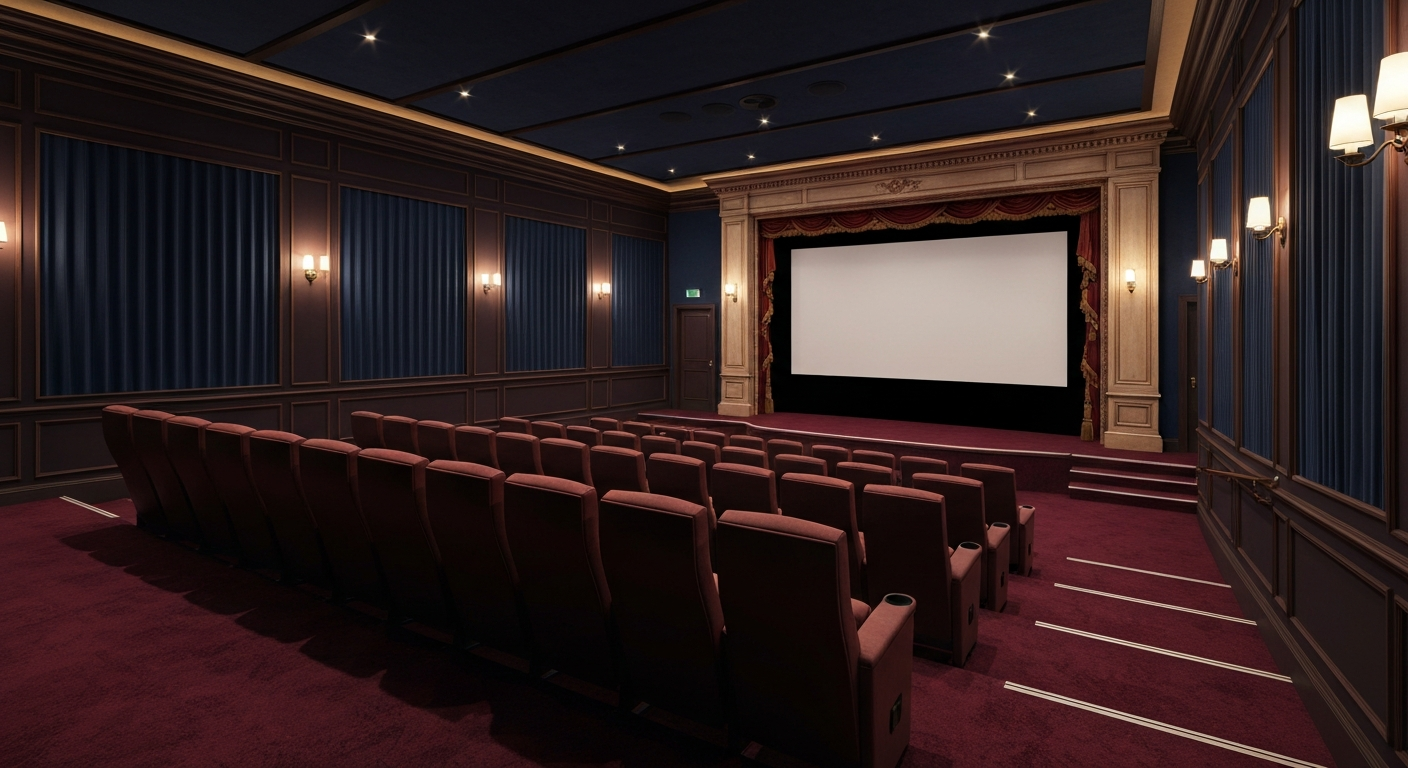
Curtains, sconces, fabric-wrapped acoustic walls, a proscenium frame around the screen, tiered seating, deep carpet, warm low-temperature lighting. This is the most timeless theater concept — borrowed from 1940s movie palaces and still the gold standard in 2026.
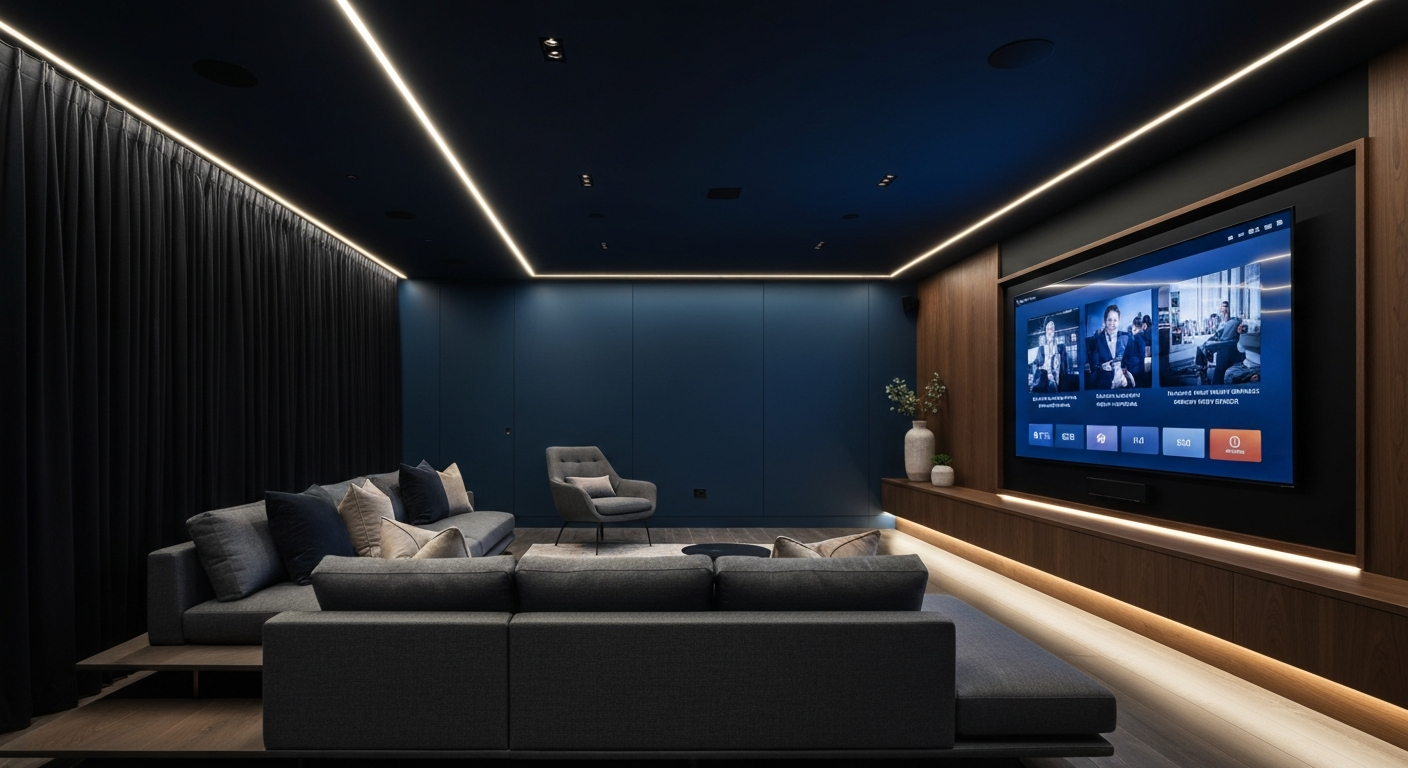
A continuation of the home's contemporary aesthetic. Smooth fabric panels, integrated linear lighting, a TV or short-throw laser projector mounted into custom millwork, modular sectional seating instead of theater rows. Common in luxury Memorial and Bellaire renovations where homeowners want the room to feel like an extension of the living space, not a departure from it.
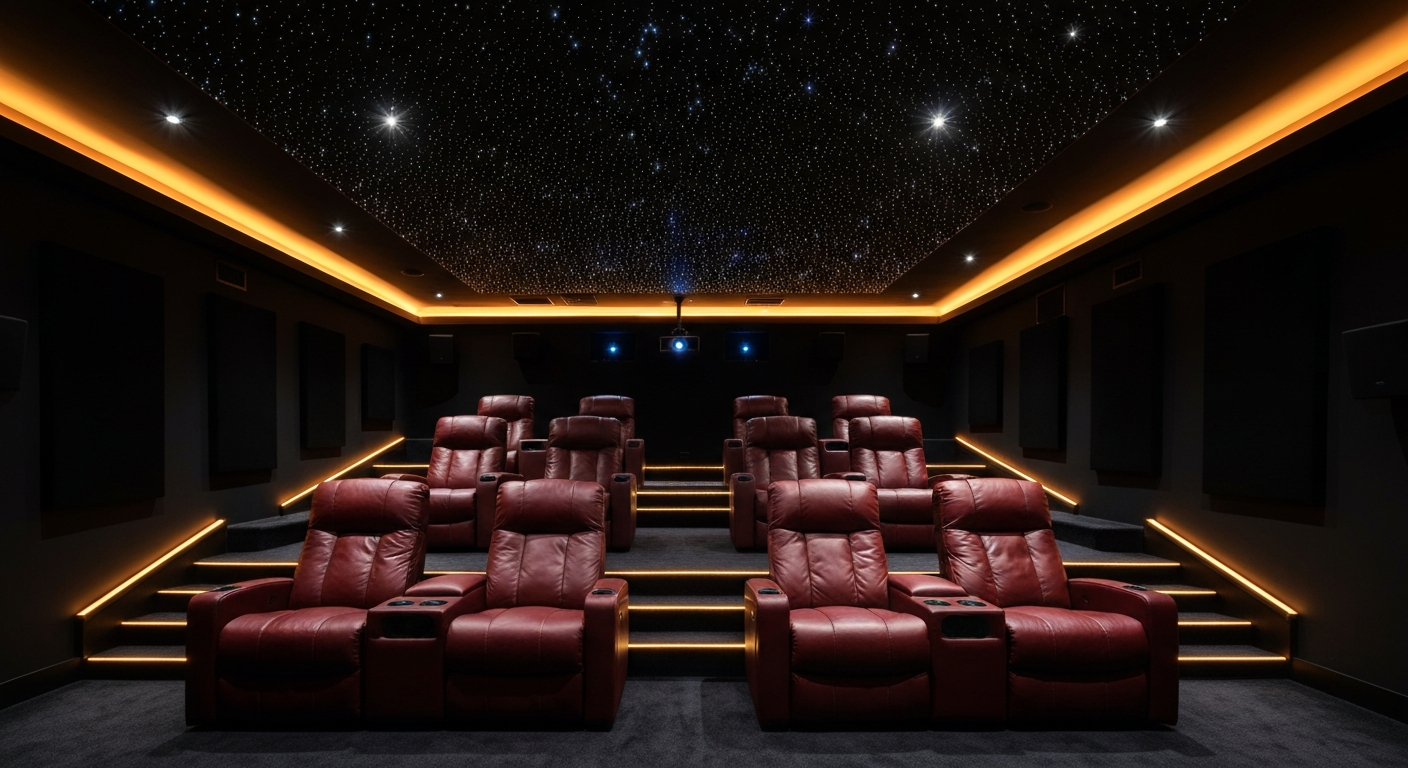
The full theatrical experience — proscenium, curtains, fiber-optic starfield ceiling, anamorphic widescreen, columns, custom millwork, themed entry, dual rows of dedicated theater seating with a riser. These projects regularly exceed 600 square feet and become the architectural centerpiece of a lower level.
3. Design the Sightlines Before You Place a Single Speaker
In any room with more than one row of seats, sightlines determine whether the second row works or feels like an afterthought. The right approach:
- —Screen center on a 15° downward viewing angle from the front row eye position
- —Second row riser of 8–14 inches depending on screen size and front-row depth
- —No seat positioned more than 30° off the central axis of the screen
- —Screen-to-front-row distance roughly 1.5× the screen width for 4K content
4. Treat Acoustics as an Architectural Decision
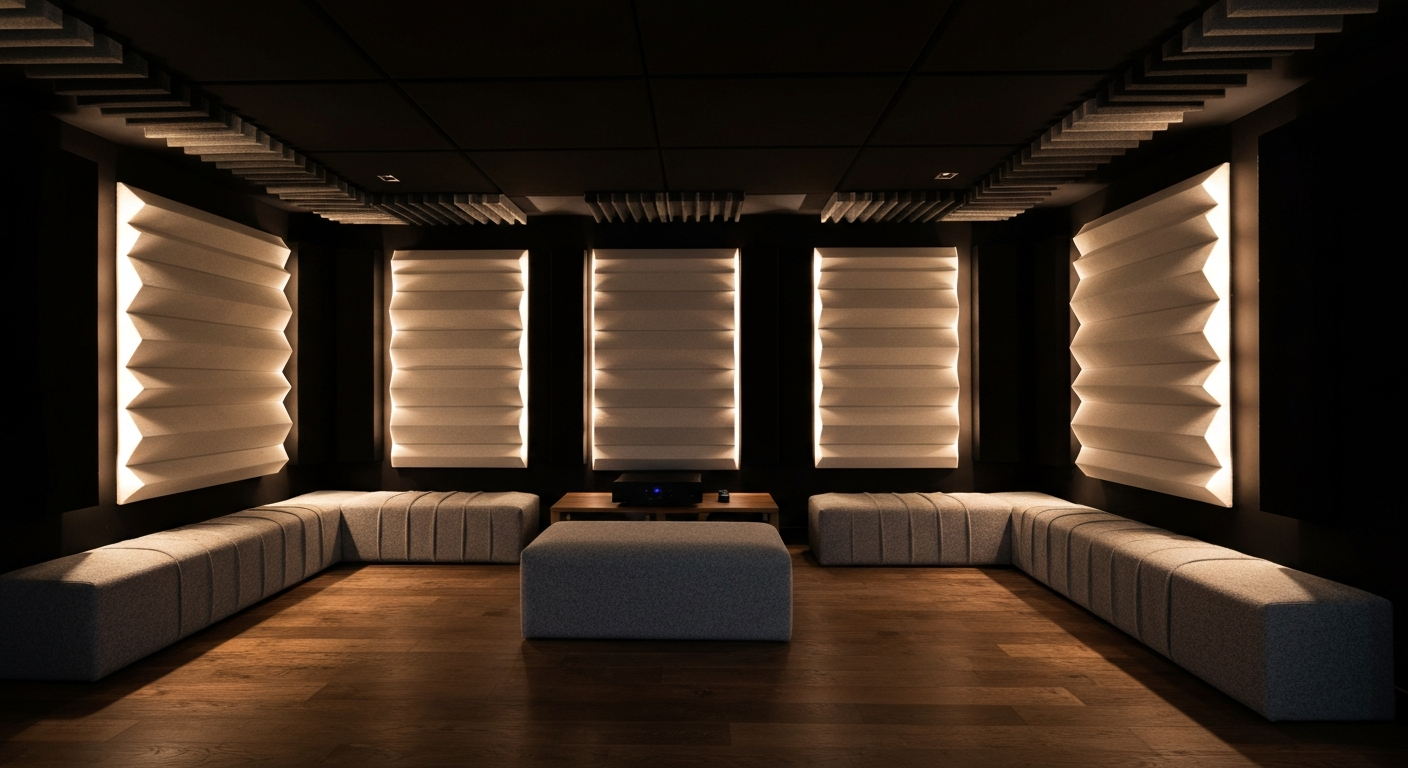
A reference-grade audio system in an untreated room will sound worse than a modest system in a properly treated one. Acoustic treatment isn't decorative — it's structural to how the room performs.
The integrated approach we recommend: bass traps in all four corners (hidden behind fabric-wrapped panels that match the room's aesthetic), absorption panels at first-reflection points on side walls and ceiling, diffusion panels on the rear wall, and solid-core doors with acoustic seals.
Done right, none of this is visible. The walls look like designer fabric panels. The ceiling looks like a coffered architectural feature. The room sounds like a recording studio and looks like a Ralph Lauren ad. This is what acoustic optimization means in a luxury build — design and engineering working as one.
5. Pick Your Display Strategy Carefully
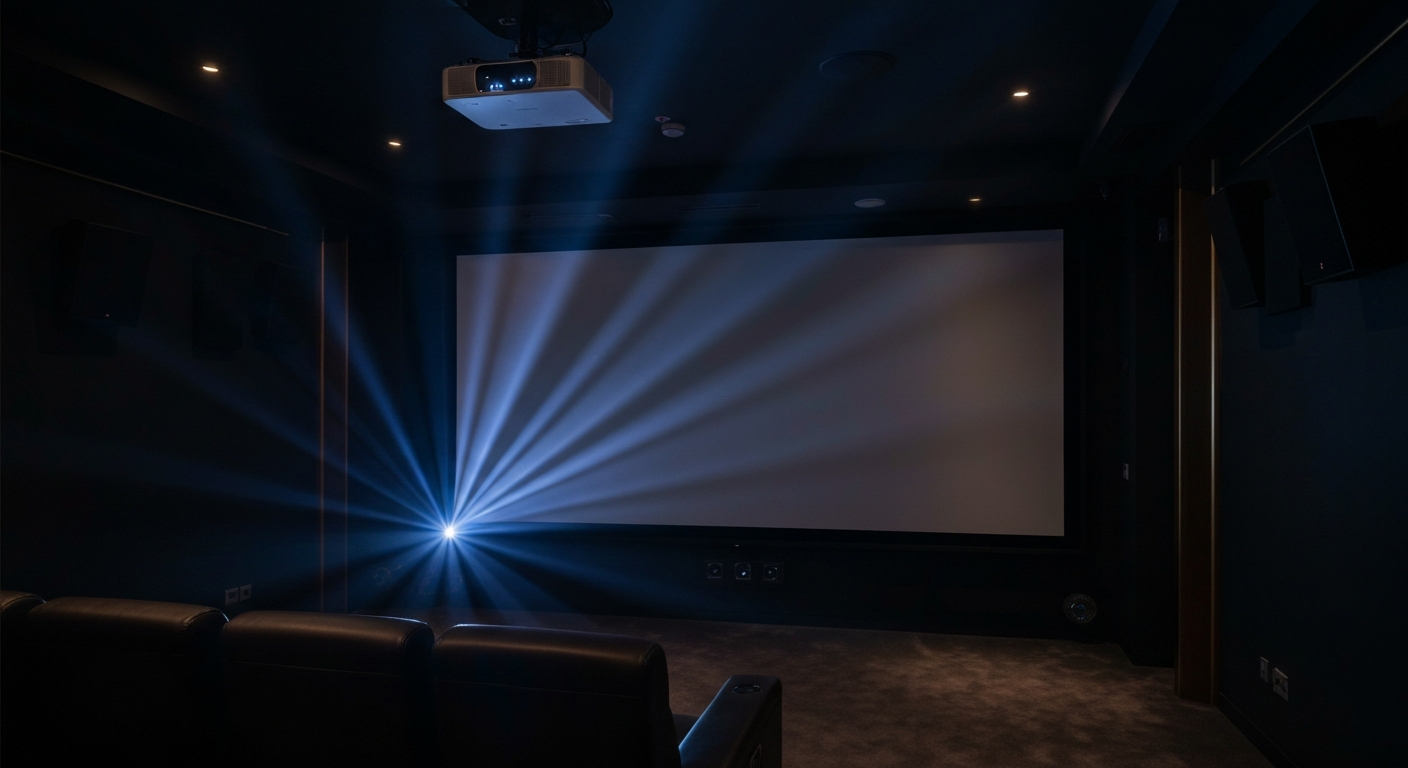
4K / 8K Laser Projector + Screen
The path for dedicated theaters. A premium laser projector (Sony, JVC, Barco) paired with an acoustically transparent screen lets you mount the center channel speaker behind the screen — exactly where it lives in a real movie theater. Screen sizes from 120" to 200" diagonal.
Large-Format MicroLED / OLED
The path for media rooms and modern living spaces. Samsung, LG, Sony, and Hisense are now shipping 98", 115", and 136" displays that perform beautifully even with windows open — no light-control demands of a projector.
6. Hide the Speakers, Not the Performance
Architectural audio — speakers built into the wall, ceiling, or behind acoustically transparent surfaces — is the default in luxury Houston theaters. Visible speakers in a $4M home feel like an architectural failure.
A proper Dolby Atmos 7.2.4 layout uses 11 speakers and 2 subwoofers — and in a luxury build, you should be able to walk into the room and not be able to point to any of them. The performance is everywhere. The visual presence is nowhere. Hidden architectural speakers are also what makes whole-home audio work — your theater becomes one zone in a system that extends through the rest of the house.
7. Use Lighting as a Storytelling Tool
Lighting design is the single most underrated element in luxury home theater design. The luxury lighting strategy uses three or four layers, each on its own control: cove lighting (indirect linear LED in tray ceilings), sconces (theatrical wall-mounted fixtures), step lighting (low-level LEDs at riser edges), and accent lighting (picture lights, downlights, and fiber-optic starfield ceilings for estate theaters).
Every layer is dimmable, every layer is on its own circuit, and every layer is tied to scenes through Lutron lighting control. A single "Movie" command should fade the cove down, kill the accents, drop the sconces to 8%, and bring the step lights to safety level — all in a four-second transition. This is the moment a luxury theater feels luxurious. Not when the picture comes on. When the lights move.
8. Design the Seating as Architecture
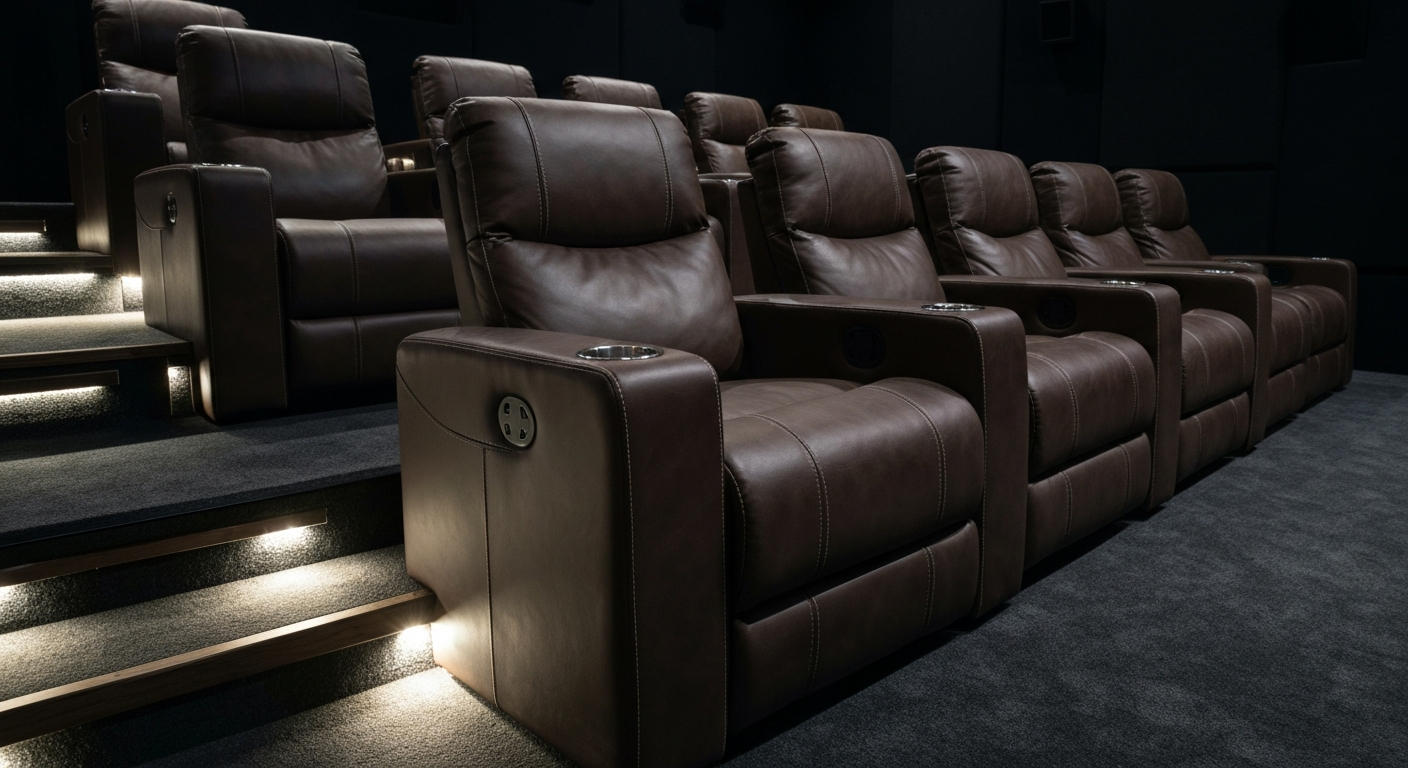
Theater seating has evolved dramatically. The current generation from Fortress, Cinematech, Elite HTS, Cineak, and Valencia delivers power recline, heated and cooled seats, tactile transducers (so on-screen explosions are felt as well as heard), console seating with hidden storage, and USB-C charging built in.
Plan for 6–10 seats in most luxury theaters. Two rows of four with a center aisle is the most versatile configuration. The design conversation isn't "which chair?" — it's "how do these chairs work as architecture?" Custom millwork around the seat backs, riser carpeting that meets the seat base cleanly, and consistent leather across all seats are all design moves that matter.
9. Integrate the Smart Home Layer From Day One
A luxury home theater that requires three remotes, two apps, and a working knowledge of receiver menus is not a luxury home theater. The integration layer is what makes the technology feel like furniture.
A properly integrated theater uses Control4, Crestron, or Savant as a single brain. Choosing the right platform is critical for long-term satisfaction — learn more in our head-to-head comparison: Control4 vs Savant: Which Smart Home System Is Better?.
Scenes worth programming in every luxury theater:
- "Movie"— Full theatrical lighting transition, screen down, projector on, source selected, shades closed
- "Sports"— Moderate ambient light, slightly lower bass profile, second row lights up
- "Intermission"— Soft up-light, pause everything, raise climate, step lights to full
- "Goodnight"— Everything off, system locked, lights restored to the rest of the floor
10. Material Choices That Hold Up
Luxury home theaters lean on three material categories: soft (acoustic), tactile (sensory), and visual (architectural). The standouts on our projects: wool or wool-blend carpet, aniline leather on seats, fabric-wrapped acoustic panels in warm muted tones, and stained walnut or white oak millwork.
Avoid shiny chrome accents, busy patterns, and trendy colors. Luxury theaters age into themselves — they shouldn't have a vintage.
Houston-Specific Design Considerations
Humidity Control
Houston's climate is hard on speakers, electronics, and leather. Theater HVAC should hold tight humidity ranges (35–50%), especially in interior rooms with no exterior walls.
Window Management
Many luxury Houston homes have large window arrays even on lower levels. Motorized blackout shades (Lutron Sivoia, Hunter Douglas) integrated with lighting scenes solve the problem cleanly.
Pre-Wire During Construction
We work with custom builders across The Woodlands, Cinco Ranch, Bridgeland, and Riverstone to incorporate AV infrastructure at framing — the cost difference vs. retrofit is often 3–5× in our clients' favor.
HOA & Architectural Review
In River Oaks, West University, Memorial, and Tanglewood, exterior alterations require review. Plan early — we coordinate directly with your architect and builder.
Ready to Design Your Luxury Home Theater?
The best time to bring us into the conversation is before drywall, before millwork, before furniture decisions get locked in. We offer a free consultation — no pressure, no hard sell.
Frequently Asked Questions
What makes a home theater "luxury" instead of standard?
A luxury home theater is defined less by its equipment list and more by its integration: dedicated room design, professional acoustic treatment, architectural-grade installation, custom lighting scenes, hidden speakers, smart home control, and design coherence with the rest of the home. A standard home theater can have expensive gear; a luxury home theater is engineered as a room from the framing forward.
What's the ideal size for a luxury home theater room?
Most premium luxury theaters in Houston fall between 280 and 600 square feet, with a length-to-width ratio of roughly 1.5:1 and a ceiling height of 9 to 14 feet. Smaller rooms can still deliver excellent experiences, but tiered seating and proper acoustic spacing typically require at least 20 feet of length.
What's the difference between a home theater and a media room?
A home theater is a dedicated, light-controlled room engineered for cinematic immersion — projector, theater seating, acoustic treatment, isolated audio. A media room is a multi-use space designed to perform well with ambient light, typically built around a large 4K TV or short-throw projector, with comfortable sectionals and surround sound. Many luxury Houston homes include both.
Should I use a projector or a TV in a luxury home theater?
For a fully dedicated, light-controlled theater room — a 4K or 8K laser projector with an acoustically transparent screen is the right choice. For a multi-use media room or a space with windows, a large-format MicroLED or OLED display (98" to 136") delivers exceptional image quality without the projector's light-control demands. Many luxury Houston homes include one of each.
How important is acoustic treatment in a luxury theater?
It's the single biggest performance factor after speaker selection. A reference-grade audio system in an untreated room will sound worse than a modest system in a properly treated one. In luxury builds, acoustic treatment is engineered into the architecture — hidden inside designer fabric panels, decoupled walls, and ceiling structures — so it disappears visually while transforming the sound.
Do luxury home theaters need smart home integration?
Yes. A luxury theater that requires multiple remotes and apps to operate isn't really a luxury theater. A proper Control4, Crestron, or Savant integration ties projector, audio, lighting, shading, climate, and sources into a single interface. One-touch scenes are the standard at this level.
Can a home theater be built into an existing Houston home?
Yes. We retrofit luxury home theaters into existing Houston homes every year — in Memorial, Bellaire, West University, River Oaks, and beyond. Retrofits require more carpentry and creative cable routing than new construction, but the result is identical when done well.
How long does designing and building a luxury home theater take?
From design approval to final calibration: typically 4 to 12 weeks depending on scope. Estate-tier theaters with custom millwork and full integration can extend to 4–6 months when coordinated with broader construction schedules.
Do you serve Katy, Sugar Land, The Woodlands, and beyond Houston?
Yes. We design and install luxury home theaters across the greater Houston area and all of Texas — including Katy, Sugar Land, The Woodlands, River Oaks, Memorial, West University, Austin, Dallas, and San Antonio.
AudioVision Design — Texas' premier AV and automation integrators since 1997.
Explore our home theater installation services →AudioVision Team
AudioVision Design · Texas
Ready to Plan Your Project?
Get a free consultation with our team — no pressure, no hard sell.